

A long flight can take you across continents in hours—but your body clock does not travel quite as fast.
You arrive at your destination exhausted, your hotel check-in is still hours away, and you have a meeting, connecting flight or family plans waiting. You may not need a full night's sleep. You simply need somewhere comfortable to close your eyes, shower, freshen up and reset.
That is where an hourly hotel or short-stay room can make a practical difference.
Travel fatigue and jet lag are not exactly the same thing, but both can leave you struggling to function after a demanding journey. Understanding how travel affects sleep—and knowing when to rest, nap or simply take a break—can make the hours between journeys much easier.
How Travel Disrupts Your Sleep
Travel can interfere with sleep in several ways: changing time zones, breaking normal routines, sleeping in unfamiliar environments, and spending long periods sitting in transit.
For many travellers, the problem starts before they even reach their destination.
An overnight flight can replace your normal bedtime with cabin lights, announcements and uncomfortable seating. A delayed connection can extend an already exhausting journey. An early arrival can leave you with several hours to fill before your accommodation is available.
Your body needs time to adjust to these changes.
Time-zone changes can confuse your body clock
Your circadian rhythm helps regulate when you feel sleepy and when you feel alert. Crossing multiple time zones can temporarily put that internal rhythm out of sync with the local time.
This is the basis of jet lag.
According to the CDC, jet lag can cause symptoms including sleep disruption, daytime fatigue, difficulty concentrating, and a general feeling of being unwell after crossing time zones. Eastward travel usually requires the body clock to advance, while westward travel requires it to be delayed. For many people, adapting to westward travel is somewhat easier.
The result can be surprisingly frustrating: it may be afternoon at your destination, but your body feels as though it is the middle of the night.
Unfamiliar environments can make sleep harder
Even when you are tired enough to sleep, a new environment may not feel immediately comfortable.
Different lighting, unfamiliar sounds, room temperature, travel stress and changes to your usual routine can all affect sleep. Research into the first-night effect has found that people can experience changes in sleep when staying somewhere unfamiliar.
That matters when you travel frequently.
Sometimes the solution is not another activity or another cup of coffee. It is simply having a quiet, private place where you can rest.
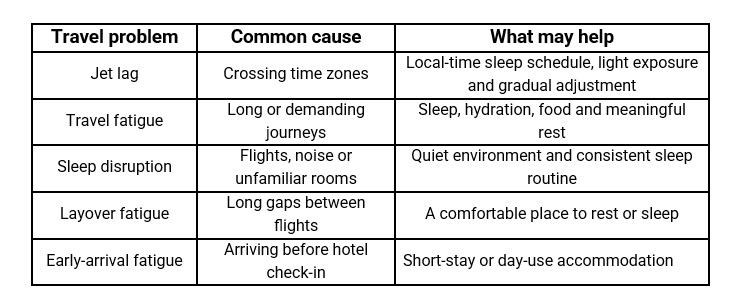
Jet Lag vs Travel Fatigue: What's the Difference?
The terms are often used interchangeably, but they describe different travel problems.
Jet lag is primarily related to crossing time zones and the resulting mismatch between your internal body clock and local time.
Travel fatigue is broader. It can result from long journeys, insufficient sleep, uncomfortable transport, waiting around, stress, disrupted meals and physically demanding travel—even when you have not crossed a time zone.
Imagine flying from Mumbai to London for a business meeting.
You cross several time zones, sleep poorly on the flight, and land in the morning. Your hotel check-in is not until the afternoon, but your meeting begins later that day.
You do not necessarily need another full hotel night.
You may simply need a few uninterrupted hours to sleep, shower, change clothes, and recharge.
That is where a hourly hotel booking can fit into the journey.
How to Sleep Better During and After a Long Flight
There is no single trick that eliminates travel fatigue, but a few practical habits can make a noticeable difference.
1. Adjust your schedule gradually
If you know you are crossing time zones, start moving your sleep schedule toward your destination time when practical.
Once you arrive, try to follow the local schedule rather than repeatedly switching between your home time and destination time.
2. Make your flight environment sleep-friendly
Small changes can make a long flight more comfortable.
Consider carrying:
- An eye mask
- Earplugs or noise-cancelling headphones
- A comfortable travel pillow
- Loose, comfortable clothing
- Water
- Anything you normally need for your bedtime routine
Reducing light and noise can make it easier to sleep when the cabin environment allows it.
3. Be careful with caffeine
Caffeine can help you stay alert when you genuinely need to be awake, but consuming it too close to your intended sleep period may make falling asleep harder.
The CDC notes that caffeine's effects can last for several hours, so timing matters when you are trying to adapt to a new sleep schedule.
4. Avoid treating every tired moment with a stimulant
When you are exhausted after a long journey, another coffee may seem like the easiest solution.
But sometimes you are not lacking caffeine—you are lacking sleep.
If your schedule allows it, a short period of genuine rest can be more useful than trying to push through several hours of fatigue.
Should You Nap After a Long Flight?
Sometimes, yes—but timing matters.
A short nap can help reduce immediate tiredness, particularly when you need to function after arriving. The CDC suggests keeping daytime naps relatively short, around 20–30 minutes, when trying to adjust to a new time zone.
Longer daytime sleep may make it harder to sleep at the appropriate local bedtime for some travellers.
However, there is an important difference between a short recovery nap and desperately trying to stay awake after an overnight journey.
If you have had very little sleep and have several hours before your next obligation, having a comfortable place to get meaningful rest may be more practical than trying to survive the wait in an airport lounge or public seating area.
Light Is One of Your Best Jet-Lag Tools
Light plays an important role in regulating your circadian rhythm.
Getting natural light at an appropriate time can help your body adjust toward the local schedule. The timing matters because light exposure can shift your internal clock differently depending on when you receive it.
This is why simply telling yourself to “get more sunlight” is not always enough.
Your destination, direction of travel and current sleep schedule all matter.
For travellers crossing several time zones, it can be useful to plan sleep and daylight exposure around the destination rather than following your old schedule throughout the trip.
What About Melatonin?
Melatonin is often discussed as a way to manage jet lag, but it is not a universal solution.
Evidence suggests that appropriately timed melatonin may help some travellers with circadian adjustment, but timing and individual circumstances matter. If you are considering melatonin, especially if you take medication or have an underlying health condition, speak with a healthcare professional first.
The bigger picture is more straightforward:
Good sleep conditions still matter.
A supplement cannot replace an uncomfortable chair with a proper bed, a noisy terminal with a quiet room, or several hours of waiting with genuine recovery time.
The Missing Piece: Where Do You Rest Between Journeys?
This is the part of travel that traditional accommodation does not always solve.
Hotels are usually designed around overnight stays. But modern travel does not always happen on an overnight schedule.
You may have:
- A six-hour airport layover
- An early-morning arrival
- A late-night departure
- A delayed flight
- A long gap between check-out and your next journey
- A business meeting between two flights
- A few hours before your accommodation's standard check-in time
In these situations, booking an hourly hotel can give you access to a private room for the period you actually need.
Instead of paying for an entire night, travellers can look for hourly rooms, hotels by hour, hotel for day use options or hotels for short stay.
For example, an hourly hotel booking can give a traveller somewhere to:
- Sleep for a few hours
- Take a shower
- Change clothes
- Work privately
- Rest between flights
- Recharge before a meeting
- Recover after a long journey
For travellers searching for early check-in hotels, a short-stay room can also provide an alternative when a standard hotel room is not yet available.
Qwiksta helps travellers find flexible hotel and room stays for situations such as layovers, early arrivals, delays and gaps between journeys—giving them a private place to rest, refresh and recharge when they need it.
Hourly Hotel vs Airport Lounge: What Do You Actually Need?
An airport lounge can be useful when you want food, Wi-Fi, seating and a quieter environment.
But if your main goal is sleep, privacy or a proper shower, your needs may be different.
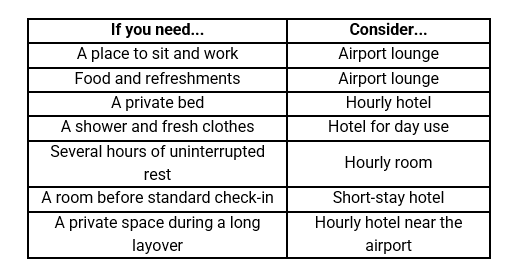
The right option depends on how long you have and what you need to accomplish before continuing your journey.
A Simple Travel-Fatigue Recovery Plan
When you are exhausted, complicated plans rarely work. Keep your recovery routine simple.
Before travelling
Check your itinerary and identify potential sleep gaps.
If you have an overnight flight, long layover or very early arrival, decide in advance where you can rest.
During the journey
Drink water regularly, keep your sleep environment as comfortable as possible, and avoid relying entirely on caffeine to compensate for lost sleep.
When you arrive
Move toward the destination's local schedule.
Get appropriately timed daylight, eat at reasonable local times and avoid turning every tired moment into a long daytime sleep.
During a long layover
Ask yourself what your body actually needs.
If you only need to sit and answer emails, a lounge may be sufficient.
If you need to sleep, shower and recover privately, searching for an hourly hotel near me, hotels near airport or hourly service apartment may make more sense.
Before your next journey
Give yourself enough time to wake up, shower, eat, and reach your next transport connection without rushing.
Rest is more useful when it does not create another logistical problem.
FAQs
How can I sleep after a long flight?
Create conditions that resemble your normal sleep environment: reduce light and noise, avoid unnecessary screen stimulation, and give yourself enough uninterrupted time to rest. If you are between flights or waiting for hotel check-in, an hourly hotel or private day-use room can provide a more suitable place to sleep than an airport terminal.
What is the best way to recover from jet lag?
Gradually align your sleep, meals, and daily activities with the destination's local time. Appropriately timed daylight can also help your circadian rhythm adjust. Avoid depending solely on caffeine to overcome sleep loss.
How long should I sleep during a layover?
It depends on your schedule and how much sleep you have already had. A short 20–30-minute nap may help with temporary tiredness, while travellers with significant sleep loss may need a longer uninterrupted rest period. Consider how the timing of your sleep will affect your next scheduled sleep period.
Why am I so tired after travelling even without jet lag?
Travel fatigue can happen without crossing time zones. Long journeys, poor-quality sleep, early departures, delays, uncomfortable seating, stress and irregular meals can all contribute to exhaustion.
Where can I rest during a long layover?
Depending on the airport and your itinerary, options may include airport lounges, airport hotels, hourly hotels, day-use rooms and short-stay accommodation. If sleep and privacy are your priorities, look specifically for an hourly room or hotel for day use.
Are hourly hotels useful for early arrivals?
Yes. If your flight arrives several hours before standard hotel check-in, an hourly hotel or short-stay room can give you somewhere to rest, shower, work or change before continuing with your day.
The Bottom Line
Jet lag and travel fatigue can turn a simple journey into a surprisingly exhausting experience. Crossing time zones affects your body clock, while long journeys and disrupted routines can leave you tired even when you have not changed time zones.
The solution is not always to sleep for an entire night.
Sometimes you need a short nap. Sometimes you need daylight and a normal meal. And sometimes you simply need a quiet room for a few hours before the next part of your journey.
That is why an hourly hotel can be a useful part of modern travel planning—especially for layovers, early arrivals, delays and the awkward gaps between check-out and your next departure.
When your next journey leaves you with a few hours between destinations, how will you choose to use that time?